Unit 2.1 – Basics of Data Literacy
Q1. What do you mean by Data Literacy?
Answer:
Data Literacy means the ability to read, understand, analyse and use data in a correct way.
A data-literate person can collect data, understand what it means, check if it is correct, and use it to make better decisions.
Q2. Draw Data Pyramid. Explain its different parts.
Data Pyramid:
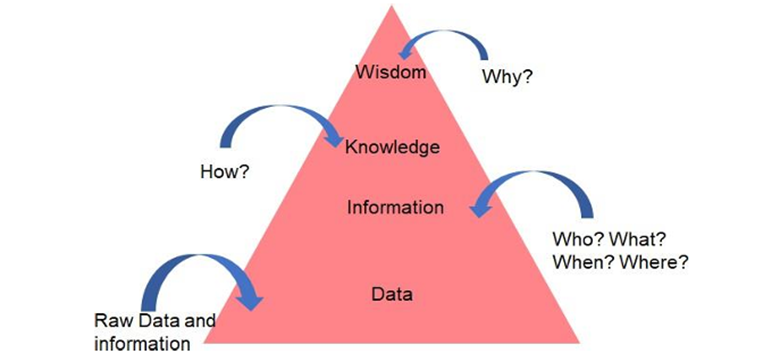
Explanation:
- Data: Raw facts and figures (Example: 50, 60, red, blue).
- Information: When we organise data in a meaningful way. (Example: Rohan scored 50 marks).
- Knowledge: When we understand information and use it for decision-making.
(Example: Rohan needs to study more because his marks are low.)
Q3. Why is Data Literacy important?
Answer:
Data Literacy is important because it helps us:
- Understand the information around us.
- Make correct and informed decisions.
- Stay safe by knowing about data privacy and security.
- Work with technologies like AI that depend on data.
Q4. What are the different steps of the Data Literacy Process Framework? Explain each briefly.
Answer:
The Data Literacy Process Framework has six steps, and each step helps in improving data literacy skills:
- Plan:
In this step, the goal of the program is defined, participants are identified, and the execution strategy and timeframe are discussed. - Communicate:
A communication plan is made to explain the purpose of the goal clearly and to take commitment from the participants. - Assess:
Participants are introduced to a data literacy assessment tool to check their skill level and comfort with data. - Develop Culture:
The program is adopted and data literacy skills are improved through continuous learning. These skills slowly become part of the organisation’s culture. - Prescriptive Learning:
Different learning resources are provided so that individuals can choose the ones that suit their learning style. - Evaluate:
An evaluation metric is created to measure the progress of the program and to decide how often this progress should be checked.
Q5. Define Data Privacy and Data Security. Why is it important?
Answer:
Data Privacy means protecting a person’s personal information and allowing only authorised people to access it. It ensures that our personal details are not shared or used without our permission.
Data Security means protecting data from hackers, viruses, theft, or any unauthorised access. It includes using strong passwords, encryption, and security systems to keep data safe.
Importance:
Data Privacy and Data Security are important because they keep our personal and sensitive information safe, prevent misuse of data, protect us from cybercrimes, and ensure that our information is handled safely and responsibly.
Q6. What is Cybersecurity? What are the best practices?
Answer:
Cybersecurity is the process of protecting computers, mobile devices, networks, and data from online attacks such as hacking, viruses, and malware. It ensures that our digital information remains safe and secure.
Best Practices for Cybersecurity:
- Use strong and unique passwords.
- Do not click on unknown links or suspicious attachments.
- Keep antivirus and software updated.
- Do not share personal information, passwords, or OTPs with anyone.
- Use secure Wi-Fi connections.
- Take regular backups of important data.
Unit 2.2 – Acquiring Data, Processing and Interpreting Data
Q7. Explain different types of data.
Answer:
1. Qualitative Data (Non-numerical Data)
Qualitative data describes qualities, characteristics, or features.
It cannot be measured in numbers.
It tells how something looks, feels, or behaves.
Examples:
- Colour of a dress (red, blue)
- Taste of food (sweet, salty)
This kind of data helps in understanding descriptions and behaviours.
2. Quantitative Data (Numerical Data)
Quantitative data is expressed in numbers.
It can be measured, counted, and compared.
Examples:
- Height (150 cm)
- Age (14 years)
Q8. Differentiate between Qualitative and Quantitative data?
| Qualitative Data | Quantitative Data |
| It is non-numerical data. | It is numerical data. |
| Describes qualities, features, or characteristics. | Describes quantities or measurements. |
| Cannot be measured in numbers. | Can be measured, counted, and compared. |
| Example: colour of a shirt, taste of food, opinions, feelings. | Example: height, marks, age, price, temperature. |
| Used to understand descriptions and behaviours. | Used for calculations, graphs, and statistical analysis. |
Q9. Name different AI domains. Explain the type of data used in each domain.
Answer:
There are three main AI domains, and each domain uses a different type of data:
1. Computer Vision
Type of Data Used:
- Images
- Videos
Computer Vision focuses on understanding and analysing visual data.
Example: Face recognition, object detection.
2. Natural Language Processing (NLP)
Type of Data Used:
- Text
- Speech
- Audio
NLP helps machines understand and respond to human language.
Example: Chatbots, translation apps.
3. Data Science
Type of Data Used:
- Numerical data
- Tabular data (rows and columns)
- Statistical data
This domain uses numbers to find patterns and make predictions.
Example: Predicting sales, weather forecasting.
Q10. What do you understand by Data Discovery, Data Augmentation and Data Generation?
or
What are the three steps involved in the data acquisition process?
Answer:
1. Data Discovery
Data Discovery is the process of finding and collecting data from different available sources.
It includes identifying where the required data exists and gathering it so that it can be used further in the AI project.
2. Data Augmentation
Data Augmentation means increasing the amount of data by adding slightly modified copies of existing data.
This helps when we have less data and need more data for training an AI model.
3. Data Generation
Data generation refers to generating or recording data using sensors
● Recording temperature readings of a building is an example of data generation
Q11. Differentiate between Primary Data and Secondary Data.
Primary Data is the first-hand data collected directly by the researcher for a specific purpose. It is usually more accurate because it is collected by us through methods like surveys, interviews, or observations.
Secondary data collection obtains information from external sources, rather than generating it personally. Some sources for secondary data collection include data from books, newspapers, reports, and websites.
Q12. What is Good data and Bad data?
Answer:
Good Data:
Good data is data that is clean, complete, accurate, and properly structured.
It does not contain duplicates, missing values, or errors, and it matches real-world facts.
Good data is reliable, useful, and suitable for analysis, so it helps AI systems give correct results.
Bad Data:
Bad data is data that is unclean, inaccurate, incomplete, or poorly structured.
It may contain missing values, duplicate entries, mistakes, outdated information, or irrelevant details.
Bad data reduces the quality of analysis and can make AI systems give wrong or biased outputs.
Q13. What is Web Scraping? Is it legal or illegal?
Answer:
Web Scraping is the process of automatically collecting data from websites using special tools or programs.
It is legal if the website allows it.
It is illegal if done without permission (especially private data).
Q14. What are the Ethical concerns while acquiring data?
Answer:
While gathering data and choosing datasets, the following ethical concerns must be taken care of:
1. Bias
We should take steps to understand and avoid any preferences or partiality present in the data.
2. Consent
We must take necessary permission before collecting or using an individual’s data.
3. Transparency
We should clearly explain how we plan to use the collected data and must not hide our intentions.
4. Anonymity
We must protect the identity of the person who is the source of the data.
5. Accountability
We should take responsibility for our actions in case the data is misused.
Q15. What are the primary factors that determine the usability of data? Explain each.
Answer:
There are three primary factors that determine how usable and reliable data is:
1. Structure
Structure tells us how the data is stored and organized.
Well-structured data is easy to access, read, and analyse.
2. Cleanliness
Clean data is free from duplicates, missing values, outliers, and errors.
When the data is clean, it becomes more reliable and useful for analysis.
In the given example from the book, duplicate values were removed during the cleaning process.
3. Accuracy
Accuracy shows how correctly the data represents real-world values.
Accurate data matches the actual measurements and does not contain mistakes.
In the book example, the accuracy was checked by comparing the measured length of a small box in centimeters.
Note:
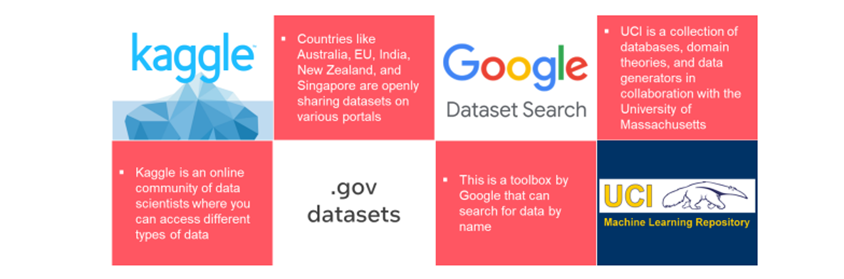
On platforms like Kaggle, each dataset is given a usability score based on ratings provided by users. This helps others understand how good and usable the dataset is.
Q16. Define Data Features. What are dependent and independent features?
Answer:
Data Features are the individual measurable properties or characteristics of the data that are used by an AI model.
They help the model understand patterns and make predictions.
Independent Features
Independent features are the input variables.
They are the factors that influence or affect the output, but they are not affected by other variables.
Example:
Hours studied, temperature, age, height, etc.
Dependent Features
Dependent features are the output variables.
Their value depends on or changes because of the independent features.
Example:
Marks scored (depends on hours studied), sales prediction (depends on price, demand), etc.
Q17. Explain Acquire Data, Data Processing, Data Interpretation, Data Analysis and Data Presentation.
Answer:
- Acquire Data: Collecting data from different sources.
- Data Processing: Cleaning data and removing mistakes.
- Data Interpretation: Understanding the meaning of data.
- Data Analysis: Finding patterns and trends using maths/statistics.
- Data Presentation: Showing data using graphs, charts, tables.
Q18: What is the difference between Data Processing and Data Interpretation?
Data Processing
▪ Data processing helps computers understand raw data.
▪ Use of computers to perform different operations on data is
included under data processing.
Data Interpretation
▪ It is the process of making sense out of data that has been
processed.
▪ The interpretation of data helps us answer critical questions
using data.
Q19. What are the two methods of Data Interpretation?
Answer:
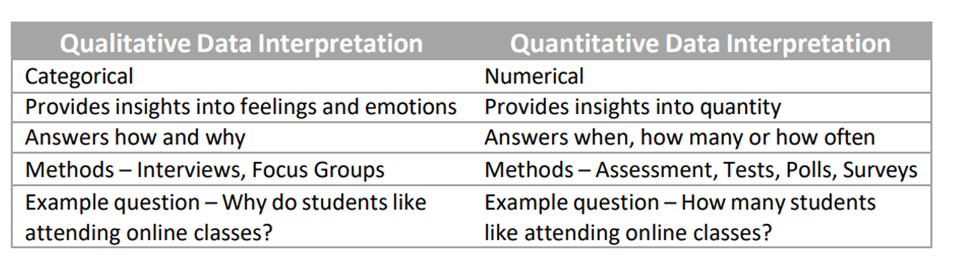
- Qualitative Interpretation: Understanding non-numerical information (feelings, opinions).
- Quantitative Interpretation: Understanding numerical data using graphs and statistics.
Q19. What is trend analysis? Is it possible to see trends on the Internet? How?
Answer:
Trend Analysis is the process of studying patterns or changes in data over a period of time.
It helps us understand whether something is increasing, decreasing, or staying the same.
Trend analysis is useful for making predictions and understanding behaviour or performance.
Q-20:Is it possible to see trends on the Internet? How?
Yes, it is possible to see trends on the Internet.
We can use online tools and platforms that show what people are searching for, talking about, or using.
For example, websites like Google Trends or social media platforms show trending topics.
These tools analyse large amounts of data and display the most popular or rising trends in the form of graphs, charts, or lists.
Q20. How is Qualitative data interpretation different from Quantitative data interpretation?
Answer:
Q21. What are the different collection methods used for Qualitative data interpretation?
Answer:
- Record keeping: This method uses existing reliable documents and other similar sources of information as the data source. It is similar to going to a library.
- Observation: In this method, the participant – their behavior and emotions – are observed carefully
- Case Studies: In this method, data is collected from case studies.
- Focus groups: In this method, data is collected from a group discussion on relevant topic.
- Longitudinal Studies: This data collection method is performed on the same data source repeatedly over an extended period.
- One-to-One Interviews: In this method, data is collected using a one-to-one interview.
Q22. What are the different collection methods used for Quantitative data interpretation?
Answer:
Interviews: Quantitative interviews play a key role in collecting information.
Polls: A poll is a type of survey that asks simple questions to respondents. Polls are usually limited to one
Observations: Quantitative data can be collected through observations in a particular time period
Longitudinal Studies: A type of study conducted over a long timeSurvey: Surveys can be conducted for a large number of people to collect quantitative data.
Survey: Surveys can be conducted for a large number of people to collect quantitative data. I
Q23. If we have a lot of data that is not clean, is it good for AI?
Answer:
No.
Dirty, incorrect or incomplete data makes AI predictions wrong.
AI needs clean and correct data to work properly.
Q-24: What is the difference between Continuous Data and Descrete Data?
Answer:
Numeric Data is classified as:
● Continuous data is numeric data that is continuous. E.g., height, weight, temperature, voltage
● Discrete data is numeric data that contains only whole numbers and cannot be fractional
E.g. the number of students in the class – it can only be a whole number, not in decimals
Q25: What are the different types of Data Interpretation?
Ans:
1.Textual DI
▪ The data is mentioned in the text form, usually in a paragraph. ▪ Used when the data is not large and can be easily comprehended by reading.
2. Tabular DI
▪ Data is represented systematically in the form of rows and columns. ▪ Title of the Table (Item of Expenditure) contains the description of the table content.
3. Graphical DI
Bar Graphs
In a Bar Graph, data is represented using vertical and horizontal bars.
Pie Charts
▪ Pie Charts have the shape of a pie and each slice of the pie represents the portion of the entire pie allocated to each category
▪ It is a circular chart divided into various sections (think of a cake cut into slices)
Pie Charts
▪ Pie Charts have the shape of a pie and each slice of the pie represents the portion of the entire pie allocated to each category
▪ It is a circular chart divided into various sections (think of a cake cut into slices)
Q26: What is the importance of Data Interpretation?
1. Informed Decision Making
- A decision is only as good as the knowledge it is based on.
- Example:
- When the average height of students is known, the school can custom design chairs and tables according to students’ requirements.
2. Reduced Cost
- Identifying needs can help reduce unnecessary expenses.
- Example: A restaurant owner can remove or modify dishes from the menu that are not popular or have received bad reviews, reducing wastage and cost.
3. Identifying Needs
- Data interpretation helps in identifying the needs of people.
- Example: By studying data, we can understand what people require and take action accordingly.
Unit 2.3 – Project Interactive Data Dashboard & Presentation
Q26. Name any two Data Visualization tools used in AI.
Answer:
1. Tableau
Tableau is a powerful data visualization tool used to create interactive charts, graphs, and dashboards. It helps users understand complex data easily and is widely used for data analysis and presentation.
2. Microsoft Power BI
Power BI is a data visualization and business intelligence tool that helps in collecting, analysing, and visually presenting data. It allows users to make dashboards and reports that support better decision-making.
Q27. At which stage of the AI Project Cycle does Tableau software prove useful?
Answer:
Data Exploration and Data Presentation stage.
Q28. Name any five graphs that can be made using Tableau software.
Answer:
1. Bar Graph
A bar graph uses rectangular bars to compare different categories. It is useful for showing which category has the highest or lowest value.
2. Line Graph
A line graph shows data points connected by lines. It is used to observe trends or changes over time.
3. Pie Chart
A pie chart shows data in the form of a circle divided into slices. Each slice represents a part of the whole, making it useful for showing percentages.
4. Scatter Plot
A scatter plot displays data as dots on a graph. It helps show the relationship between two variables (for example, height vs. weight).
5. Histogram
A histogram shows the distribution of numerical data. It groups values into ranges (bins) and helps understand how often each value appears.
Q29. What is the importance of Data Visualization?
Answer:
Data visualization helps to:
- Understand data quickly
- Find patterns and trends
- Explain information easily
- Make better decisions
Book pdf: https://cbseacademic.nic.in/web_material/Curriculum26/publication/secondary/AI_Facilitators_Handbook_IX.pdf