Q1. What do you understand by Generative AI? How is Generative AI different from Conventional AI?
Ans: Generative artificial intelligence (AI) refers to the algorithms that generate new data that resembles human-generated content, such as audio, code, images, text, simulations, and videos.
| Aspect | Generative AI | Conventional AI |
| Goal | Creates new content such as text, images, music, etc. | Analyzes, processes, and classifies existing data |
| Training | Uses large datasets and complex neural networks to learn patterns and generate new content | Uses comparatively simpler algorithms and limited training methods |
| Output | Produces fresh, innovative, and sometimes unexpected results | Produces predictable results based on existing data |
| Applications | Used in art, music, literature, gaming, and design | Used in banking, healthcare, image recognition, and language processing |
Q2. Explain four types of Generative AI. Give some examples of Gen AI applications.
Four Types of Generative AI :
- GANs (Generative Adversarial Networks)
GANs consist of two neural networks: a Generator and a Discriminator.- The generator creates new data samples.
- The discriminator checks whether the data is real or fake and gives feedback.
- Both networks work in a feedback loop until the generated data becomes almost identical to real data.
Examples: Creating images of non-existing people, converting day images to night, generating images from text, realistic videos.
- VAEs (Variational Autoencoders)
VAEs are generative models that learn the distribution of data and then generate new samples from it.- They help in producing fresh data similar to the training data.
- VAEs are also used for reconstruction and creative generation.
Examples: Generating new images similar to given ones, image reconstruction, writing drafts, creating new sounds and music.
- RNNs (Recurrent Neural Networks)
RNNs are designed to work with sequential data such as text, music, or time-based information.- They use past inputs to predict future outputs.
- Very useful when order and sequence matter.
Examples: Generating text in the style of an author, predicting the next word or character in a sentence, music generation.
- Autoencoders
Autoencoders are neural networks trained to compress data into a smaller representation and then reconstruct it.- Mainly used for data compression and noise removal.
- They can also generate realistic samples.
Examples: Image denoising, picture compression, artistic image creation, drug discovery.
Generative AI has many applications, from art and music to language and natural language processing.
Here are some examples of how generative AI is being used in various fields:
▪ Art: Generative AI is being used to create unique works of art.
▪ For example, The Next Rembrandt project used data analysis and 3D printing to create a new painting in the style of Rembrandt.
▪ Music: Generative AI is being used to create new music, either by composing original pieces or by remixing existing ones.
▪ For example, AIVA is an AI composer that can create original pieces of music in various genres.
Language: Generative AI is being used to generate new language, such as chatbots that can hold conversations with users or natural language generation systems that can produce written content.
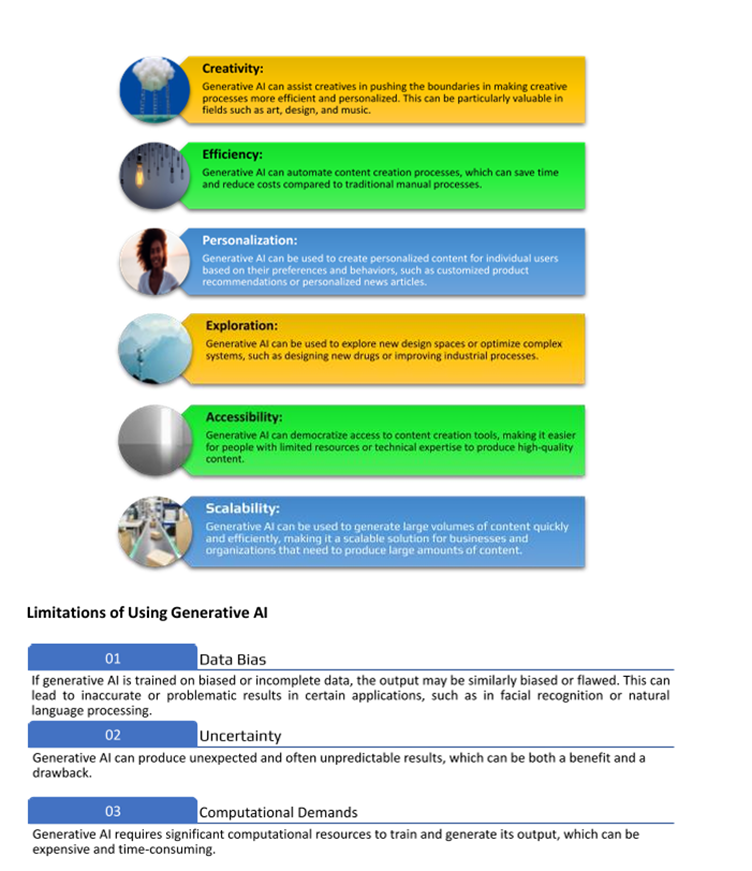
Q3. What are the benefits and Limitations of using Gen AI.
Benefits of using Gen AI:
Q4. Name any 10 Gen AI tools.
Ans: Generative AI tools:
- ChatGPT – Text generation
- Notion AI – Text and productivity
- Compose AI – Writing assistance
- Midjourney – Image generation
- Magic Studio – Image editing and creation
- Pebblely – AI product images
- Muse AI – Video generation
- Visla AI – Video creation
- Topaz AI – Video and image enhancement
- Piggy AI – Design and presentation creation
Q5. What are the potential negative impacts of AI on society?
Ans: The Potential Negative Impact on Society :
● Generative AI can be used to create fake news or deep fakes that can spread misinformation and manipulate public opinion.
● Lead to job displacement for humans who previously performed these tasks.
● Generative AI has the potential to generate sensitive personal information, such as social security numbers or medical records, which could be used for malicious purposes.
Q6. How to use Generative AI responsibly?
Ans : Responsible Use of Generative AI
● Ensuring that the training data used are diverse and representative.
● The outputs are scrutinized for bias and misinformation.
● Prioritizing user privacy and consent,
● Having clear guidelines around ownership and attribution of generative content.